


Danger Assessment
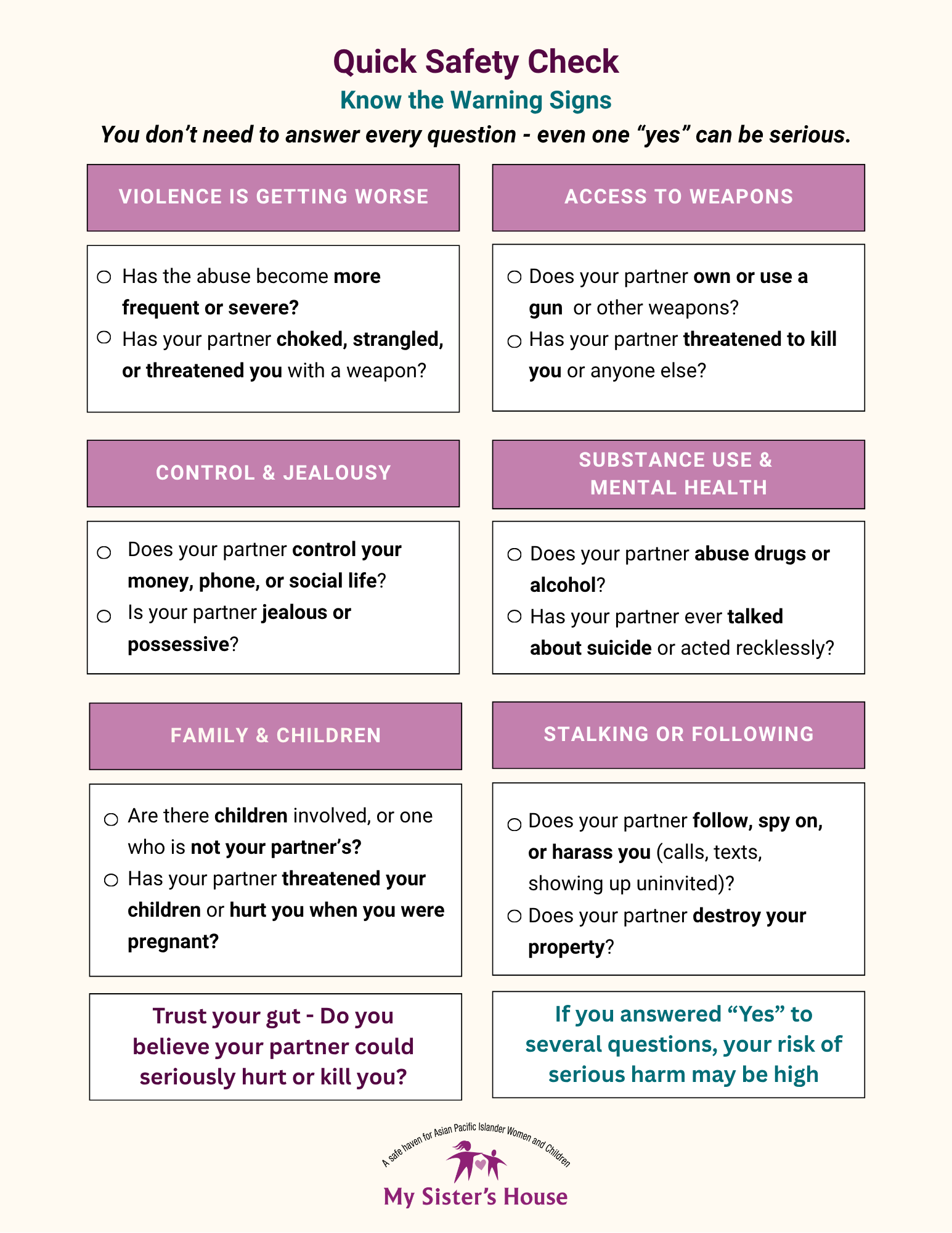

Signs of Abuse
- Jealousy
- Controlling Behaviors
- Quick Involvement
- Unrealistic Expectations
- Isolation
- Blames Others for Problems
- Hypersensitivity
- Cruelty to Animals or Children
- “Playful Use of Force in Sex
- Verbal Abuse
- Rigid Sex Roles
- Mood Swings
- Past Battering
- Threats of Violence
- Breaking or Striking Objects
- Any Force During an Argument
Recognizing Abusive Behaviors
Abuse doesn’t always start with physical violence. It can begin subtly, often disguised as love, concern, or intense affection. Over time, the behaviors become more controlling and harmful, aiming to dominate and isolate the victim. Below are common warning signs of abuse:
Jealousy
Jealousy is often mistaken for love early in a relationship. In reality, it’s a sign of insecurity and possessiveness.
An abuser may:
- Constantly question who you’re talking to
- Accuse you of flirting
- Express jealousy over time spent with family, friends, or children
Controlling Behavior
Controlling actions may be framed as concern or care but are rooted in power and control.
This can include:
- Anger when you’re “late”
- Dictating what you wear, where you go, or who you see
- Controlling finances or making you ask permission to leave the house
Quick Involvement
Many victims dated or knew their abuser for less than six months before they were engaged or living together. Abusers can come on like a whirlwind. They need someone desperately, and can pressure the partner to commit to them.
Unrealistic Expectations
Abusers are sometimes very dependent on the victim for all of their needs with the expectation the victim to be the perfect partner, mother, lover, friend. They will say things like “If you love me, I’m all you need – you’re all I need.”
Isolation
The abuser could try to cut the victim off from all resources. The abuser may accuse people who are supportive of “causing trouble.”
This can include:
- Preventing you from working, going to school, or seeing family and friends
- Taking away access to a phone, car, or internet
- Accusing others of “causing trouble” in your relationship
Blames Others For Problems
An abuser may:
- Blame unemployment or failures on others
- Say you “distracted” them when mistakes are made
- Hold you responsible for anything that goes wrong
Hypersensitivity
Abusers are easily insulted, claiming that feelings are “hurt” when they are really, really mad, or they take the slightest setbacks as personal attacks.
They may:
- Overreact emotionally
- Claim their feelings are hurt when they’re actually angry
- Frequently talk about how the world is “against them
Cruelty To Animals Or Children
Abusers may be violent toward pets or insensitive to their suffering. The abuser may expect children to be capable of doing things far beyond their ability (hits a two-year-old for wetting a diaper) or may tease children or young brothers and sisters until they cry.
“Playful” Use of Force in Sex
These people may like to throw their victims and use force during sex, they may want to act out fantasies during sex where their partners are helpless. They are letting them know that the idea of “rape” excites them. They may show little concern about whether their partners wants to have sex.
Verbal Abuse
In addition to saying things that are cruel and hurtful, abusers degrading their partners, and diminishing any of their accomplishments falls into verbal abuse. The abusers may tell victims that they’re stupid and unable to function without their presence.
Rigid Gender Roles
Abusers may have strict beliefs about gender roles.
They may insist that:
- You must obey them
- You stay home and serve them
- They are superior, smarter, or more valuable than you
Mood Swings
Many victims are confused by their abusers’ sudden changes in mood and will describe that one minute they’re nice and the next minute they explode. Mood swings are typical of abusers, and these behaviors are related to other characteristics of hypersensitivity. These shifts are confusing and often make victims question themselves.
History of Abuse
Abusers may say they have abused partners in the past, but say it was their fault. The victim may hear from the relatives or ex-spouse that the person is abusive.
It is important to note: abusers may beat any partner they are involved with; circumstances do not give a person an abusive personality.
Threats Of Violence
Even if physical violence hasn’t occurred, threats are serious.
Examples include:
- “I’ll kill you.”
- “I’ll break your neck.” Abusers often minimize this by saying, “everyone talks like that,” but it is a red flag.
Destruction of Property
This behavior is used as a punishment (breaking loved possessions), but is mostly used to terrorize their partners into submission. The abusers may beat on tables with their fists, throw objects around or near their partners.
Any Force During An Argument
This may involve abusers holding partners down, physically restraining them from leaving the room, blocking their exit, locking them in a closet, any pushing or shoving.
Human Trafficking
Anyone can be a victim of human trafficking. Human trafficking victims are not limited to any age, gender, ethnicity, nationality, class, or other characteristic.
Here is a link to our page for more information on human trafficking.
Contact My Sister’s House at (916) 930-0626 or info@my-sisters-house.org if you would like more information about human trafficking. Please complete and return a Speaker Request Form to schedule a free presentation or training about human trafficking.